Conscious Physicians Psychedelics Academy
Our patients are already asking. Will we have the answers?
Our patients are already asking. Will we have the answers?
Somewhere in New Mexico today, a veteran with PTSD, a mother who has tried every antidepressant, and a patient facing the end of life are asking their clinician about psilocybin. Too often they get a shrug, a warning, or silence, and then they look for answers on their own. Are we ok with that?
Medicine begins with connection.
Psilocybin's deepest work is reconnection: to ourselves, and to one another. CPPA brings clinicians together to learn this medicine and to practice it in community and to learn from each other.
Heal the clinician. Heal the community.
I learned the power of community as a child in Iran, during the war. No one in our neighborhood went hungry. When bombs fell on one part of the city, friends and relatives across town opened their doors. We slept side by side on small cots, and as children, we were happy. Our parents carried the weight of war, but it never crushed them, because they had each other. Community creates resilience.
I saw that power again when clinicians and advocates came together to pass New Mexico’s Medical Psilocybin Act.
Yet too many of us practice in isolation: long days, hard conversations, and few places to say what we really feel. As psilocybin comes to New Mexico and beyond, no clinician should walk this path alone.
Community is health, healing, abundance and spirit. It is voice, protection, and advocacy. It is power.
That is why community comes first at CPPA. Our course gives you evidence-based best practices. Our community gives you colleagues, referrals, and friendships that sustain this work.
There is nothing more powerful than a conscious community, united.
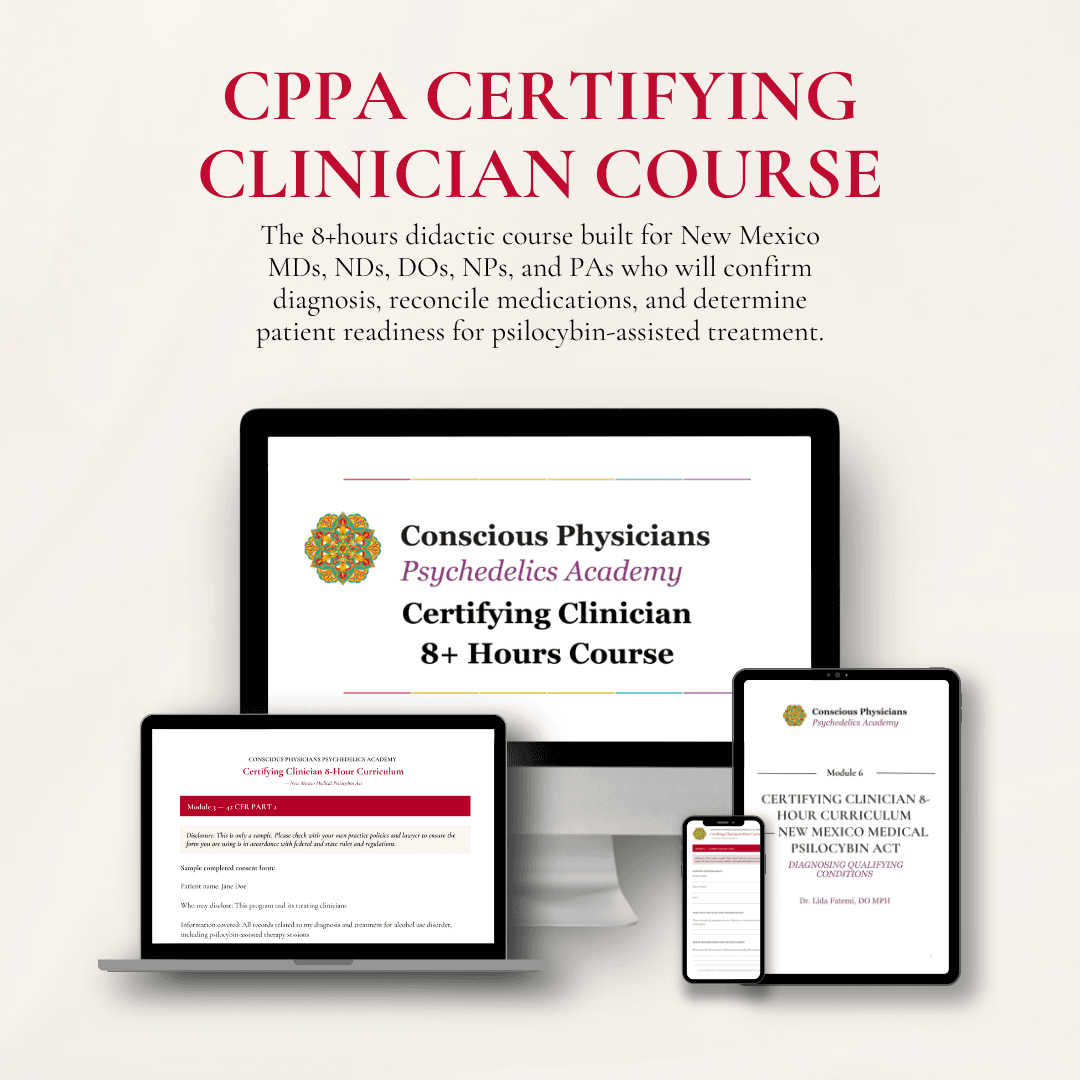
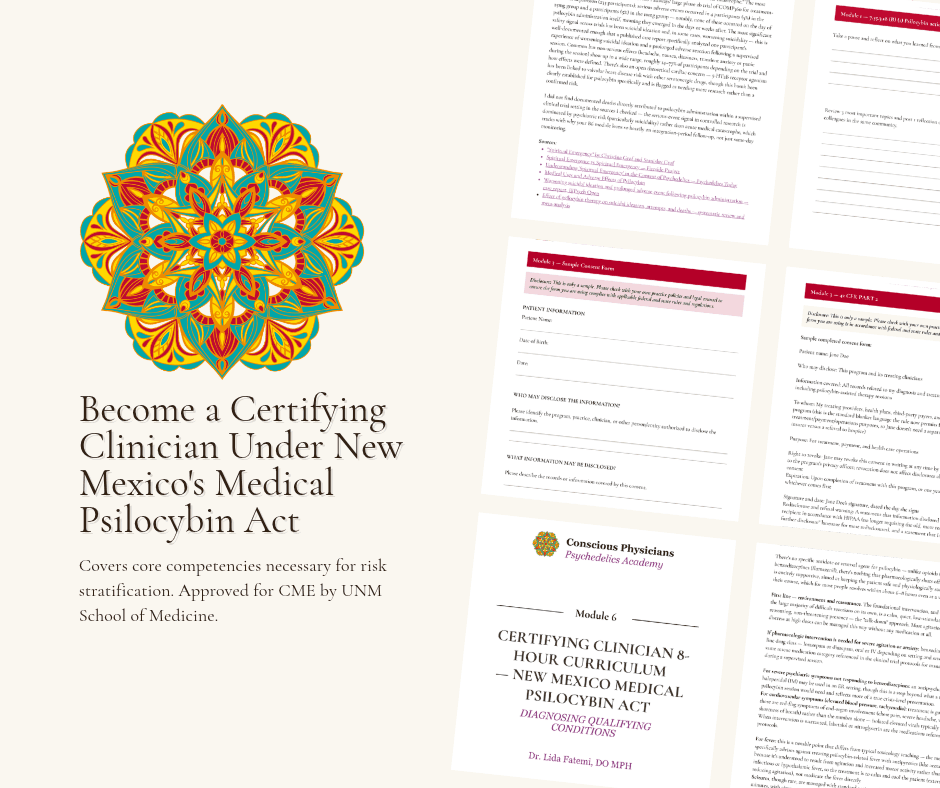
Our self-paced, 8+ hour Certifying Clinician course teaches the medical side of patient safety by considering New Mexico's Medical Psilocybin Program: screening, medical clearance, referral, and risk planning with consideration of DOH November 9th proposed rules. It is approved by the UNM School of Medicine for 7.25 AMA PRA Category 1 Credits™. You'll learn best practices on contraindications, drug interactions, and how to guide patients with confidence. This is a consultant role: you advise on medical risk; you don't run psilocybin sessions.
Short disclaimer:
This course is not approved, endorsed, or certified by the New Mexico Department of Health. The state's rules are not yet final and may change.

Who this course is for
Who this course is for
This course welcomes licensed practitioners and consultants who screen patients for medical psilocybin into one supportive community. A controlled substance registration is not required.
Under the proposed rules, that work involves two groups, and this course prepares both:
You are eligible if you:
- Consultants: Medical providers who receive referrals. Practitioners must refer patients to a medical provider when screening flags a medical risk, or when the patient hasn't seen a medical provider in the past 12 months. If you are an MD, DO, ND, NP, or PA, your patients will arrive with these questions.
- Practitioners who screen and certify patients. The Department's proposed practitioner list includes licensed therapists, counselors, social workers, psychologists, psychiatrists, psychiatric nurse practitioners, and APRNs - this list is evolving. Practitioners complete the Department's screening tool and attest to each referral and risk decision.
This is not a facilitator training program, and it does not train you to administer psilocybin or meet facilitator or practitioner certification.
What is your role as a Consultant in medical clearance?
What is your role as a Consultant in medical clearance?
Educate the patient.
On psilocybin-assisted treatment, its legal status, and potential consequences, which patients will attest they've been told.
Confirm the qualifying diagnosis
Establish and document that the patient meets a qualifying condition.
Screen for medical risk.
Use the Department's screening tool and identify contraindicated conditions, treatments, and devices.
Complete medication reconciliation.
Identify interactions, contraindications, and tapering considerations.
Refer or clear.
Refer patients with identified risks, or with no medical visit in 12 months, to a medical provider with the right scope to evaluate them.
Plan for risk.
Determine that benefits likely outweigh risks, or build a written plan the treating practitioner will follow during treatment.
Document and report.
Meet confidentiality laws under 42 CFR Part 2 and HIPAA, and the state's data collection requirements.
This course prepares you to do each of these with confidence and proper documentation, and to stay part of your patient's care.
The 8+ Hours curriculum
The 8+ Hours curriculum
CME approved by UNM School of Medicine for 7.25 AMA CME credit hours.
Core content areas:

Psilocybin action, interactions, and pharmacology
Medicine pharmacology, metabolism, dose-response, and the interaction profile that matters most in practice: SSRIs/SNRIs, MAOIs, lithium, antipsychotics, and others.
Overview of certifying clinician responsibilities
How a patient's evaluation works under the proposed rules: who screens, who refers, who attests, and where your role ends and the practitioner's and facilitator's begin.
42 CFR Part 2
Substance use disorder record confidentiality, consent, and disclosure rules applied to real psilocybin charting scenarios.
Diagnosis of qualifying conditions
Diagnostic criteria, differential diagnosis, and documentation standards for the conditions qualifying under the Act.
Determining medical clearance for psilocybin therapy
Cardiac, neurologic, and psychiatric screening; absolute versus relative contraindications; how to document a clearance or referral decision.
Psychedelic emergencies and urgencies, and medical monitoring
Spiritual emergency, holding space, psychiatric urgency and medication management, and when to escalate.
Research and data collection requirements
Documentation on what the state expects you to capture and report, and how to build it into your workflow.
Medical screening, clearance, and risk planning
Screening for the contraindications named in the proposed rules, including cardiovascular disease, hypertension, seizure history, diabetes, asthma/COPD, psychosis risk, suicidality, and serotonergic or lithium interactions. Medical devices such as pacemakers, oxygen, feeding tubes, ostomies, and pain pumps. How to document a referral decision and build a written risk plan, so medically complex and end-of-life patients aren't simply turned away.
Competency evaluation
A post-course assessment demonstrating competency across all content areas. Score 80% or higher to receive your CME credits and certificate; you have one attempt.
What we add beyond core competencies
What we add beyond core competencies
Conscious Life Practice tools
Frameworks for presence and nervous system regulation in emotionally charged patient conversations, used in preparation and integration.
Case-based learning
Real-world screening and clearance cases, including the ambiguous ones.
Expert education with two psychiatrists
Candid guidance on risk stratification, medication tapering, trauma history, and diagnostic tools, including suicidality screening.
Journeys Documentary
Understanding Psilocybin Assisted Treatment through 21 expert interviews and real patient interviews & stories. At no additional cost to you.
Continuing medical education
Continuing medical education
CME approved by UNM School of Medicine for 7.25 AMA CME credit hours.
You don't practice alone: the CPPA Clinician Community
You don't practice alone: the CPPA Clinician Community
The course is how you join. The community is why you stay: a connected, supportive place where clinicians speak freely, support each other, and refer to one another, the human community so many of us have been longing for.
Your membership includes:
- A clinician-only space to talk openly about hard cases and hard days, wins and seeking mentorship without performance or judgment. The more you give, the more you gain.
- Case consultation on de-identified cases with colleagues, plus case studies from real practice.
- Peer referrals across New Mexico, and the US, to and from clinicians you know and trust.
- Webinars on the latest psychedelic news, research and policy, including Department of Health rule changes.
- A treasure chest of resources on preparation, integration, trauma-informed care, spirituality, Indigenous practices and psychedelic art.
- Real gatherings, not just a feed. Part of every tuition funds one annual statewide gathering, and we help members host local chapter gatherings.
Included free for your first month with course enrollment. After that, $49.97/month; cancel anytime.
What you get
What you get
- Connection to a conscious community of clinicians across New Mexico and beyond
- 8+ hours of self-paced training, informed by New Mexico’s Department of Health's proposed rules as revised November 9, 2026
- 7.25 AMA PRA Category 1 Credits™, approved by the UNM School of Medicine
- Certificate of completion and CME documentation once you pass the course evaluation
- Free updated modules if the final state rules change the required content
- Your first month in the CPPA Clinician Community
- A priceless network of friends and mentors with heartfelt support
- Tuition: $900
Certifying Clinician Course
$900
8+ hours · 7.25 AMA PRA Category 1 Credits™, UNM School of Medicine · Self-paced online
Certificate of completion documenting the eight required content areas, for use with your certification application.
Certifying Clinician Course
$900
8+ hours · 7.25 AMA PRA Category 1 Credits™, UNM School of Medicine · Self-paced online
Certificate of completion documenting the eight required content areas, for use with your certification application.
Questions
Frequently Asked Questions
🌿 Heal the Clinician. Heal the Community.
New Mexico's patients are already asking. Be ready to answer.
New Mexico's patients are already asking. Be ready to answer.
We are fortunate to have you in our community.
Patients are already asking. Be ready to answer.
Learn to screen, clear, refer, and plan for risk, demonstrate competency, and join the clinicians building this standard of care in New Mexico & the US.
Heal the clinician. Heal the community.
$900 · 8+ hours · 7.25 AMA PRA Category 1 Credits™, UNM School of Medicine · Self-paced online
Learn from a clinician who helped shape the law
The course was created by Dr. Lida Fatemi, DO, MPH. She is a hospice and palliative care physician, Associate Professor at the UNM School of Medicine, legislative advisor on New Mexico's Medical Psilocybin Act (SB219), and founder of the Conscious Physicians Psychedelics Academy. She is actively involved in the Department of Health's rulemaking process and follows every development closely, so you don't have to.
Important: This course is not state-approved.
This course is not approved, endorsed, or certified by the New Mexico Department of Health. On November 9, 2026, the Department proposed revisions to 7.35.3 NMAC that would remove the separate certifying clinician role and its continuing education requirements, relying instead on practitioner screening and referral. These rules are not final and may change. We use "certifying clinician" to describe the clinical work of screening and certifying patients, not a state credential. Each clinician is responsible for meeting final state requirements.
Conscious Physicians Psychedelics Academy · Albuquerque, New Mexico
This course provides education on medical screening, clearance, referral, and risk planning with consideration of New Mexico's proposed Medical Psilocybin rules (7.35.3 NMAC). Certification decisions are made solely by the New Mexico Department of Health. Nothing in this program constitutes legal advice or a guarantee of certification from the state.
This program is educational in nature and does not provide training in psychedelic administration or medical treatment.
At the federal level, psychedelic substances remain classified as controlled substances. There is, however, increasing federal support for psychedelic research and expanding state-level frameworks, including in New Mexico, where regulated clinical models are actively being developed.
Participants are responsible for practicing within their professional scope and applicable jurisdictional laws.